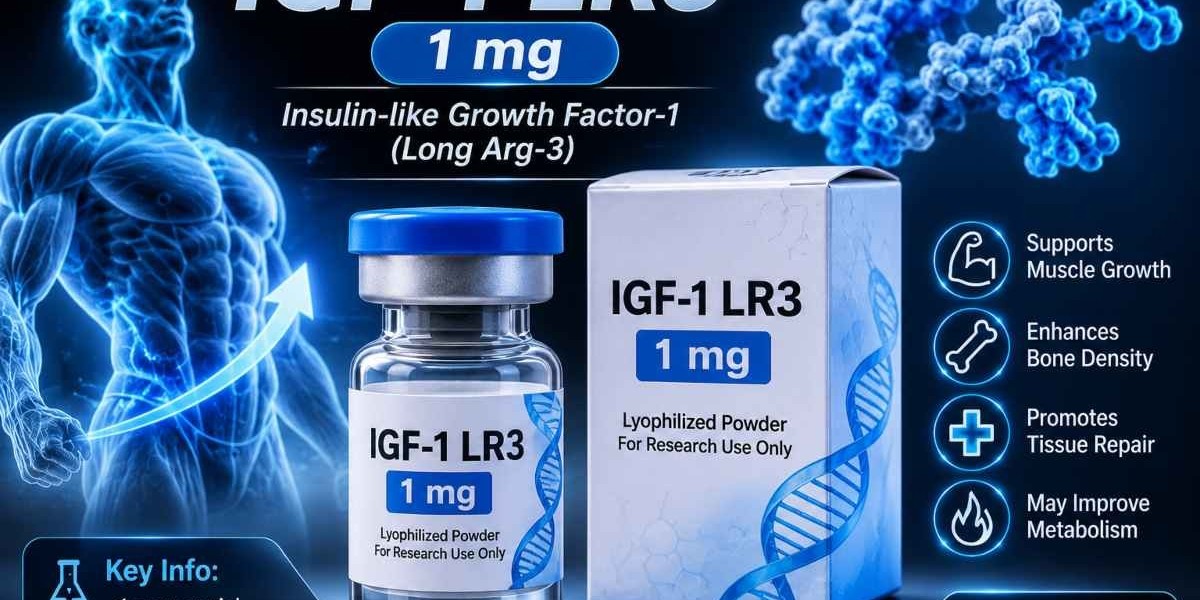

Quick answer: IGF-1 LR3 is a laboratory analog of insulin-like growth factor 1, built with 83 amino acids so it stays active longer in cell cultures. Researchers who search for IGF-1 LR3 1mg are usually comparing vial sizes, purity data, and handling standards for in vitro work. This guide explains the science in a simple, teacher-style way for research education only.
What Is IGF-1 LR3?
IGF-1 LR3 is a long-acting laboratory analog of insulin-like growth factor 1, a protein normally made in the liver. Think of native IGF-1 as a short message that cells read quickly, while the LR3 version is the same message printed on sturdier paper. In catalogs, a vial listed as igf 1 lr3 1mg only tells a scientist how much freeze-dried powder the container holds. It is sold strictly as a chemical reagent for laboratory work, not for human or animal use.
Structure and Amino Acid Changes
Native IGF-1 has 70 amino acids, while the LR3 version has 83 because of a 13-residue extension at one end. The “R3” in the name marks a swap of glutamic acid for arginine at position three. These edits weaken binding to IGF binding proteins (IGFBPs), leaving more molecules free to reach the IGF-1 receptor.
Where Is It Used in the Laboratory?
Most work happens in cell culture, where growth factors help cells survive and divide in a controlled dish. Biopharmaceutical teams add such analogs to serum-free media when growing lines like CHO or Vero cells. Many buyers searching 1mg igf 1 lr3 want a small research-grade quantity for pilot experiments before scaling up. Because the analog lasts longer in media, scientists can often plan fewer media changes.
Cell Culture and Bioprocessing
Imagine a student growing cells in serum-free medium that lacks natural growth signals. Adding a stable IGF-1 analog gives the cells a steady survival signal through the PI3K/Akt pathway. Researchers then compare cell counts and viability against a control flask.
Signaling Pathway Studies
IGF-1 binds the IGF-1 receptor, which triggers the PI3K/Akt and MAPK/ERK cascades inside cells. Because LR3 resists binding proteins, it gives cleaner results when scientists study receptor activation. Comparing it with insulin and native IGF-1 also helps map how related receptors differ.
How to Judge Quality and Purity
Quality is the first question any careful lab asks, because impurities can ruin an experiment. A trustworthy lot comes with independent testing, a lot number, and clear labeling of the freeze-dried powder. A supplier offering 1mg igf-1 lr3 should be able to show data for that exact batch, not a generic sheet. Here are the core items to look for:
HPLC purity report showing a high purity percentage
Mass spectrometry confirming molecular identity
Endotoxin result for cell culture suitability
Batch number matching the vial label
Reading a Certificate of Analysis
Start by matching the lot number on the vial with the number on the report. Next, check that the HPLC trace shows one dominant peak and that mass data fits the expected molecular weight of roughly 9.1 kDa. Finally, confirm the testing lab is independent and the report date is recent.
Regulatory and Compliance Notes
In the United States, IGF-1 LR3 is not an FDA-approved drug and is sold only for research. Any listing of igf 1 lr3 1mg should therefore carry a clear research-use-only statement. Suppliers must avoid medical claims, dosing guidance, and any suggestion of treating disease. Buyers should treat these rules as a basic trust signal when comparing sellers.
Anti-Doping Status
The World Anti-Doping Agency lists IGF-1 and its analogs on its Prohibited List under growth factors. This is another reason the material belongs only in controlled laboratory settings. Athletes and coaches should read the current WADA list directly.
Choosing a Reliable Research Supplier
A good supplier behaves like a good library: organized, transparent, and easy to verify. Look for a verifiable business address, responsive support, and consistent batch testing. Comparing a few sellers of 1mg igf 1 lr3 side by side makes weak documentation easy to spot. Use this short checklist before you order:
Published certificates of analysis for each lot
Clear research-use-only language on every page
Secure packaging and stated shipping times
Honest answers to technical questions
Red Flags to Avoid
Be careful with sellers who promise results, quote human outcomes, or hide their testing data. A vague listing for 1mg igf-1 lr3 with no batch details is a common warning sign. Unusually low prices and missing contact information deserve the same caution.
Conclusion
Understanding the science behind IGF-1 LR3 1mg starts with its structure, its stability, and its role in cell culture. Quality data, honest labeling, and legal compliance matter as much as the molecule itself. Remember that this material is for laboratory research only. When in doubt, verify every claim against primary sources.
Frequently Asked Questions
What does LR3 stand for?
LR3 means “Long R3.” The “Long” refers to the 13-amino-acid extension, and “R3” marks arginine at position three. Together they make the analog more resistant to binding proteins.
Is it the same as growth hormone?
No. Growth hormone is made in the pituitary gland and prompts the liver to produce IGF-1. The LR3 analog is a separate, engineered molecule. Both are studied in endocrinology research.
Is it approved for human use?
No. It is not FDA-approved and is supplied only as a research chemical. It should never be used outside controlled laboratory settings.